
Research explainer · Evidence checked October 26, 2026 · U.S. approval context
Eloralintide and retatrutide take different routes to treating obesity. Eloralintide activates amylin receptors; retatrutide activates GLP-1, GIP and glucagon receptors. Both remain investigational. The studies below show promising weight loss, but they tested different populations over different periods and cannot establish which medicine is better for an individual.
The main differences at a glance
| Question | Eloralintide | Retatrutide |
|---|---|---|
| What does it target? | Amylin receptors, preferentially AMY1 | GLP-1, GIP and glucagon receptors |
| How is it studied? | Once-weekly injection | Once-weekly injection |
| Current development | Phase 3 monotherapy trials underway | Phase 3 results reported |
| FDA approved? | No; investigational | No; investigational |
| Is it EloraTZP? | Eloralintide is one component of that combination | No; a different single-molecule triple agonist |
Sources: Lilly’s eloralintide explainer and retatrutide explainer. “Phase 3” describes a stage of research; it does not mean a medicine has regulatory approval.
How the mechanisms differ
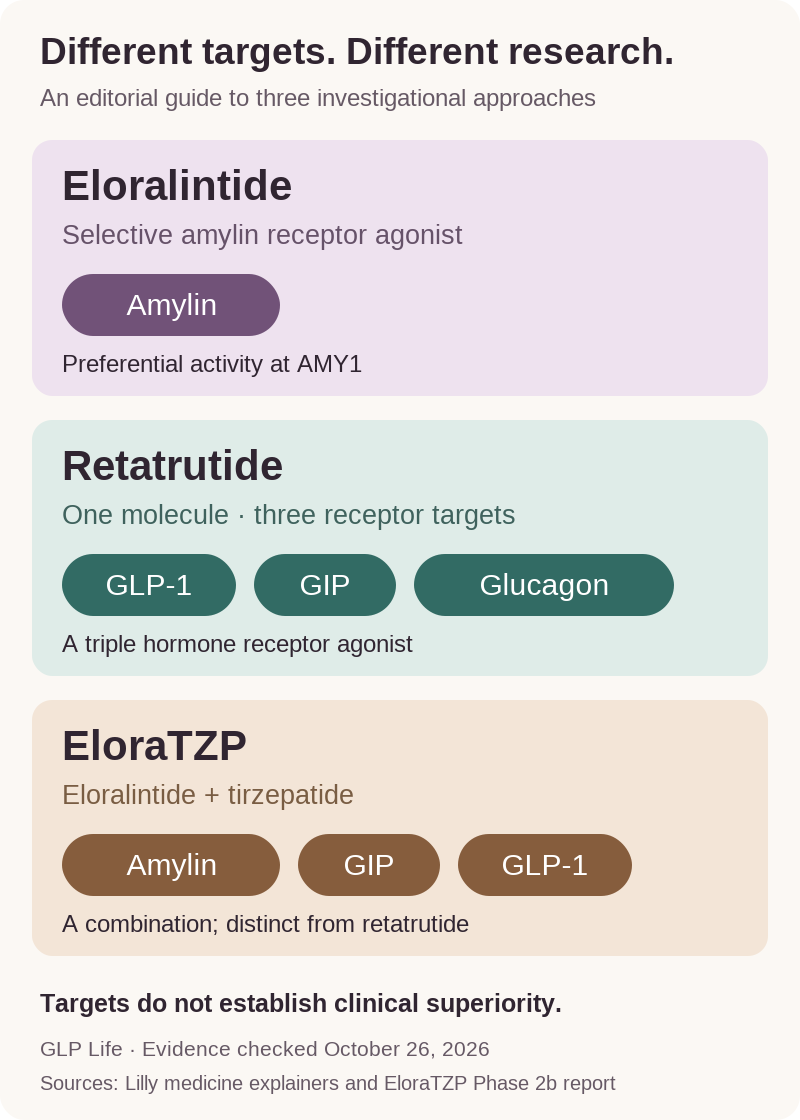
Amylin is released after eating and helps regulate fullness. Eloralintide is designed to activate this signalling pathway, with a preference for the amylin 1 receptor. It is an amylin receptor agonist, so calling eloralintide alone a GLP-1 drug misses its defining feature.
Retatrutide combines activity at three receptors in one molecule: GLP-1, GIP and glucagon. “Triple agonist” describes those targets. Lilly cautions that “GLP-3” is an inaccurate scientific label. Counting receptors also cannot tell us which treatment will offer an appropriate balance of benefit and tolerability.
What the weight-loss trials actually found
Read the duration, population and statistical approach alongside every percentage. These are average changes in trial groups, not predictions of an individual response.
| Study | Population and duration | Selected result | How it was analysed |
|---|---|---|---|
| Eloralintide Phase 2 | 263 adults with obesity or overweight and a related condition, without type 2 diabetes; 48 weeks | 20.1% average reduction in the 9 mg group; 0.4% with placebo | Efficacy estimand |
| Retatrutide TRIUMPH-1, Phase 3 | 2,339 adults with obesity or overweight and a related condition, without diabetes; 80 weeks | 25.0% average reduction in the 12 mg group; 3.9% with placebo | Treatment-regimen estimand |
| The same TRIUMPH-1 study | Same population and 80-week endpoint | 28.3% in the 12 mg group; 2.2% with placebo | Efficacy estimand |
Sources: Lilly’s eloralintide Phase 2 results, published alongside the Lancet trial; the published TRIUMPH-1 trial; and Lilly’s TRIUMPH-1 report. Doses identify research groups and are not prescribing instructions.
Why 25.0% and 28.3% can both be correct: the treatment-regimen analysis estimates the effect regardless of treatment adherence or use of prohibited weight-management treatments. The efficacy analysis estimates what would happen if participants remained on study treatment without those treatments. Those approaches answer different questions; neither figure is a guarantee.
Our interpretation: retatrutide has larger, later-stage evidence and a higher reported average reduction in these selected studies. However, the 80-week trial ran longer than eloralintide’s 48-week trial. Their eligibility criteria, dose schedules and handling of discontinued treatment also matter. Subtracting the headline percentages does not measure a comparative treatment benefit.
What changed for eloralintide in 2026?
Eloralintide is already being studied alone in Phase 3. For example, ENLIGHTEN-1 (NCT07321886) evaluates it against placebo in adults without type 2 diabetes. The registry describes a main phase and an extension; a listed completion date should not be treated as a promised launch date.
Lilly’s September 2026 EloraTZP report concerns a separate combination. In a 48-week Phase 2b trial in adults with obesity or overweight and type 2 diabetes, the highest studied combination produced 23.3% average weight loss, versus 14.8% for tirzepatide 15 mg, using the efficacy estimand.
EloraTZP combines eloralintide and tirzepatide, targeting amylin, GIP and GLP-1. Retatrutide’s third target is glucagon. The combination trial used separate injections; Lilly planned a co-formulation for Phase 3 by year-end 2026. These findings do not support combining medicines yourself.
Side effects: there is no established safety winner
In eloralintide’s 48-week Phase 2 study, common adverse events included gastrointestinal symptoms and fatigue. They were generally mild or moderate and occurred more often at higher doses. Slower escalation was associated with fewer of these events.
The TRIUMPH-1 paper reported gastrointestinal adverse events with retatrutide, including nausea, diarrhoea and constipation. It also described dysesthesia, meaning altered skin sensations, and increases in pulse rate. The investigators noted limitations, including the absence of an active comparator. A placebo-controlled trial cannot establish comparative safety against eloralintide.
Tolerability also matters for EloraTZP: in its Phase 2b report, 10.8%–27.0% of participants in combination groups stopped treatment because of adverse events. The higher weight-loss headline should be read alongside that finding. Larger and longer studies are needed to clarify benefits, risks and treatment persistence.
Approval, availability and price
As of October 26, 2026, neither eloralintide nor retatrutide is an FDA-approved treatment. Lilly’s published plan is to submit a retatrutide application in the first quarter of 2027. A planned application is not an approval decision or a confirmed public launch date.
The FDA states that retatrutide cannot be used in compounding under federal law. It also warns against unapproved drugs sold to consumers with research-use labels. An online listing does not establish that a product matches the medicine studied in a clinical trial.
This comparison therefore cannot provide a verified retail treatment price for either investigational medicine. For research participation, use official trial listings and discuss eligibility with the trial team and your clinician. For care available now, our provider comparison guide explains how to separate the clinical assessment, pharmacy route and recurring charges.
Questions readers ask
Is eloralintide a GLP-1 agonist?
No. Eloralintide alone is a selective amylin receptor agonist. EloraTZP includes tirzepatide, which adds GIP and GLP-1 activity. These names refer to different investigational approaches.
Does retatrutide cause more weight loss?
Its selected trial results show a higher average reduction, over a longer study period. The studies above do not directly compare the two drugs. They cannot establish that retatrutide would work better for a particular person.
When will either medicine be available?
There is no confirmed FDA approval or public launch date in the sources reviewed. Retatrutide’s announced filing plan and eloralintide’s trial timetable are development milestones, not availability promises.
What to watch next
The next useful comparison will examine eloralintide’s Phase 3 findings, regulatory decisions, discontinuation rates, longer-term outcomes and any direct comparative studies. Until then, keep each result attached to its trial. Our guide to FDA approval and compounding explains the regulatory distinctions behind many online offers.
About this article: This is an editorial evidence comparison, not a treatment recommendation or dosing guide. Trial findings and manufacturer plans are attributed to their sources. The article has not been reviewed by a named clinician. The cover is an original AI-generated conceptual illustration; the pathway graphic is an editorial diagram, not a molecular structure.
Sources & further reading
Where this story comes from
- lilly.comlilly.com/news/stories/what-to-know-about-eloralintide ↗
- lilly.comlilly.com/news/stories/what-to-know-about-retatrutide ↗
- investor.lilly.cominvestor.lilly.com/node/53246/pdf ↗
- doi.orgdoi.org/10.1016/S0140-6736(25)02155-5 ↗
- doi.orgdoi.org/10.1056/NEJMoa2604169 ↗
- investor.lilly.cominvestor.lilly.com/news-releases/news-release-details/lillys-triple-agonist-retatrutide-delivered-powerful-weight-loss ↗
- trials.lilly.comtrials.lilly.com/en-US/trial/664295 ↗
- investor.lilly.cominvestor.lilly.com/news-releases/news-release-details/lillys-eloratzp-combination-eloralintide-and-tirzepatide ↗
- investor.lilly.cominvestor.lilly.com/news-releases/news-release-details/lillys-triple-agonist-retatrutide-successful-two-additional ↗
- U.S. Food and Drug Administrationfda.gov/drugs/drug-alerts-and-statements/fdas-concerns-unapproved-glp-1-drugs-used-weight-loss ↗
These links support specific facts; inclusion is not an endorsement. Terms can change after the review date.
This article is general information, not medical advice. A licensed clinician who knows your history should guide treatment, prescribing, dosing, and switching decisions. Compounded drugs are not FDA approved.